 Ira Ayers’ grandfather on his mother’s side was William Lafayette Depew. Some called him Bill, but most folks called him Will. He was born in 1872 in Hancock County, Tennessee, as the oldest child of Henry and Sarah Depew. Will grew up farming and raising and shearing sheep with his brothers on his father’s farm. However, he eventually developed skills that would lead him into other occupations. Although various records indicate that he was a farmer his whole life, his daughter, Elizabeth Suckel, claims that although they lived on a farm, he never did very much farming. Instead, at various times, he was a butcher, a grocer, a surveryor and a carpenter.
In 1893 at age 20, Will Depew married Matilda Seal who was two years younger. Very little is known about her. She apparently was mostly called Tilda, but maybe also Grilla at times. Her grand daughter Rose Jordan never knew her, but remembered the name sounded like “Gorilla” to her as a little girl. Will and Tilda had four children until Tilda’s tragic death around 1904, perhaps as a result of her last childbirth. No record of death is available.
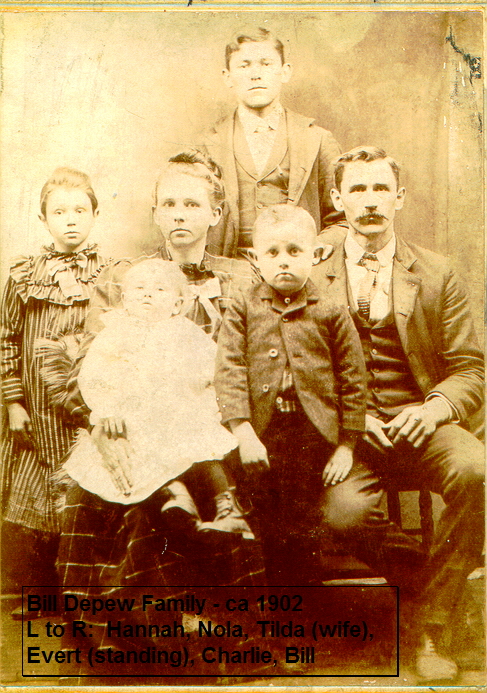
The Louisville & Nashville (L&N) Railroad was one of the first railways built in the South starting in the 1850s. After the Civil War it grew rapidly and by the turn of the century it had pushed into the coalfields of the Southern Appalachians. At Jellico, a small town on the KY and TN border, the L&N tied into the Southern Railway and continued down through the Elk Valley in Campbell County on the way to Knoxville and then Atlanta. Because of his grocer experience, around 1900 Will Depew was hired by the L&N to run its commissary at the train depot in Jellico. So, he moved his family from Hancock County to Campbell County, TN.
Unfortunately, in September 1906 Jellico was the scene of a horrendous disaster when a train car at the depot loaded with 11 tons of dynamite exploded killing 12 people nearby, and wounding some 200 more. 500 people were left homeless as the town of 3000 was devastated. It was very fortunate that Will was not a victim, but the incident apparently ended his job with the railroad as the town of Jellico had to be rebuilt.
After Tilda died, and about the time of the Jellico incident, Will met Florence Ada Ayers and they were later married in 1907. Florence was a loving and loyal wife. Between 1909 and 1932 Bill and Florence had seven daughters and two sons. Tragically, one daughter died at only one year old from measles and whooping cough, one son died from typhoid at age 20 and one son died at age 15 when struck by a car while riding a motor scooter to school. Two of their daughters, Estelle and Ethel, were twins. Their youngest daughter, Lena Elizabeth, born in 1926 still lives in Long Beach, California. She is a delightful lady and loves to talk about her memories of earlier times.
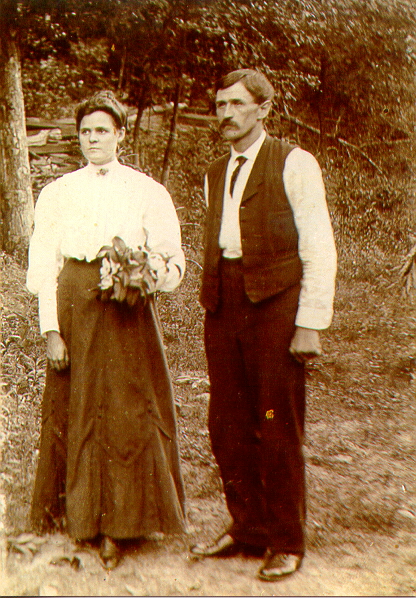
Will Depew was about 5 foot 9 inches tall with a slender build. He never was called to serve in any military capacity. According to Elizabeth, he was a quiet man who only spoke as needed. He was strong willed, determined, and sustained by his faith and perseverance. He was very strict with his children as he was raised himself. Will did all the shopping for the family. While attending a turkey shoot in his thirties, he was shot in the hip, but recovered. Elizabeth, also remembers him playing the fiddle and the organ, so he must have had a good ear for music.
After Will married Florence, he continued working as a grocer, but also learned carpentry. He eventually went on to build houses and restore churches. By 1910 Bill and Florence and their family were living in the Hickory Creek area next to Florence’s father, William Riley Ayers. In the 1920s, when Florence’s brother, Martin, decided to build a new house on Walnutt Mountain, Will helped with the carpentry work. He told Elizabeth that when work became scarce during the 1930s Great Depression, he “nickeled and dimed’ to keep the family going by fixing up places, sharpening tools and saws, and helping neighboring families with “how to” advice on many things.
Unfortunately, as he grew older, Will became badly crippled with severe rheumatoid arthritis in his hips and legs, and needed to depend on canes and crutches to get around. By 1940 he was unable to work. It was hard for him to sit with one stiff leg, so he designed a special high stool/chair to be able to sit at the table. He designed, built, stained and polished the chair with a cane seat to match the other dining chairs. Will was very innovative that way.
Florence died of cancer in 1942 and for awhile Will lived in an “old folks” home. However, about 1945 he moved to LaFollette to live with his daughter, Della Cornelius. That’s where he later died in 1956 at age 84 from a heart attack. Will is buried in the Hall Cemetery on Stinking Creek where both of his wives and both sons are also buried.


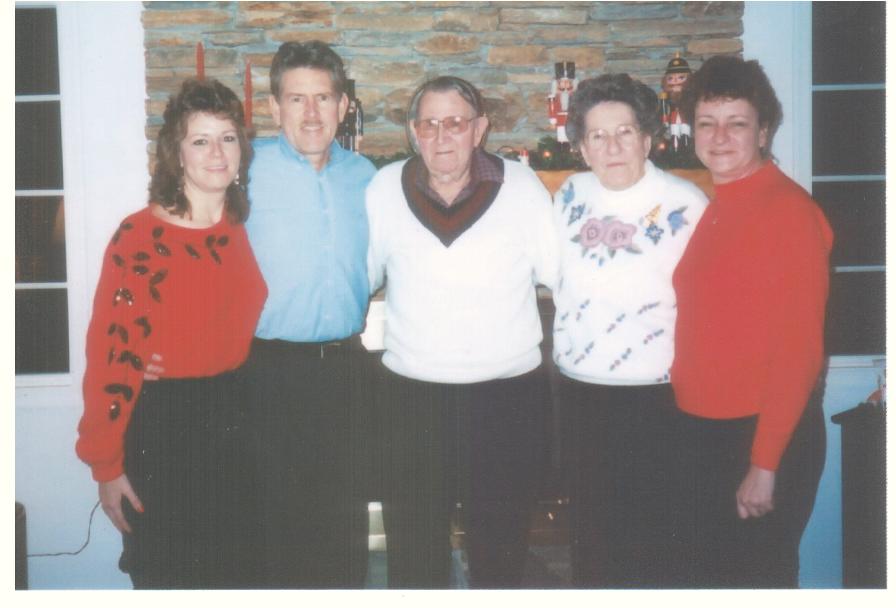






 llette, and she and some other young women like to go watch the men in the CCCs constructing Cove Lake. There she met Vurl who was a bulldozer driver. Rose and Vurl had three children: Jack, Bob, and Carolyn. They moved to Baltimore in the late 1930s where Vurl got a job at the Baltimore Shipyards, and where he continued working during WWII. After the war, he became a partner in a sawmill operation, and later owned a
 successful hardware & lumber store in Glen Burnie, MD. Rose had a sweet and gentle disposition and always wore a smile. She was a homemaker and the family attended the Nazarene Church. In the 1970s, Rose and Vurl moved to Florida, first to Homestead and then to North Ft Myers, where they spent the rest of their years. Vurl died in 1988 at age 71 and Rose died in 2001 at age 85.
 hn worked as a carpenter for many years at the Oak Ridge National Laboratories established during WWII in adjacent Anderson County, TN, as part of the effort to produce materials for a nuclear bomb. Mary was a homemaker and was a very quiet spoken lady with a quick smile. The family attended the Independent Baptist Church in LaFollette. John died in 1992 and Mary died in 2007 at age 88.


 aFollette, TN
 plus 6 months”. He was 5 ft 10 in tall and weighed 140 Lbs. His group was asked to volunteer to go over to the Army Air Forces. Not knowing what the best move would be, Ira decided to wait and see what most of the other soldiers would choose. To his dismay, his name was called first in alphabetical order. Without knowing what the others would do, he decided to step out and volunteer. This single decision may have saved his life as he spent the remainder of the war out of the infantry and mostly out of harms way.-


 The 7th Air Depot Group moved back to England in Lancashire around 29 December 1942. I remember him telling me that he was stationed near Blackpool. A post card he wrote home not long after being assigned there indicated he was in the Repair Squadron. However, he was soon assigned as an orderly in the Officers Dining Hall. The officers really liked him and he remained in this position for the remainder of the war. In the Dining Hall photo, he is standing at the far right side. It was during this period that he was promoted to Corporal.-
 eave in London

 fter return to stateside, Ira was temporarily sent to Fort McPherson, GA where he was separated from the service on 2 December 1945. In addition to his Honorable Discharge Papers, he was given a Certificate of Appreciation from Commanding General Hap Arnold of the Army Air Corps, and a Thank You Letter from President Truman.-